

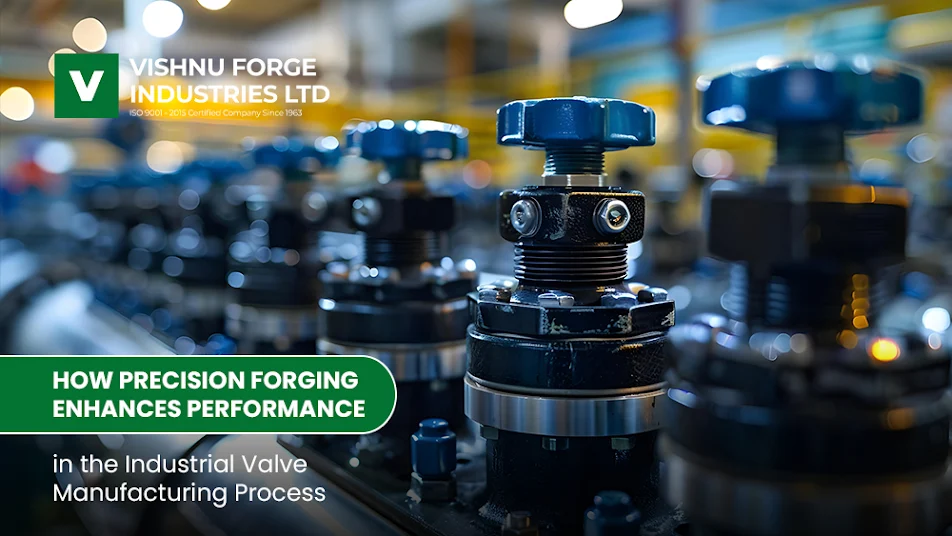
Have you ever considered what enables fluid systems to operate safely and seamlessly within refineries, chemical plants, power generation facilities, or municipal water treatment systems? At the core of such systems are the valves, and the efficient manufacturing of each valve depends on accuracy, durability, and consistency throughout the production chain.
In the last few years, precision forging has transformed the industrial valve manufacturing sector for the better. It enables the production of valves that withstand much higher pressure and extreme temperatures, and last considerably longer than those produced through traditional methods.
This blog discusses the reasons and ways in which precision forging excels in the valve manufacturing industry, and why forged components are the top choice for valve manufacturers worldwide.
The Importance of Forging in Valve Manufacturing
Valves are used to manage the flow of liquids, gases, or steam; however, controlling the flow of liquids is the easy part. Valve operation occurs in highly demanding environments with extremely high temperatures, corrosive media, pressure spikes, vibrations, and long cycle times; all of these contribute to high levels of internal and external stress on a valve’s components.
With that said, the valve is precision forged.
Forging contributes to the shaping of valves by high-temperature deformation. Forging improves the internal grain of the valve. Creating a defect on the surface of the valve.
Forging removes defects, as both the bottom and the surface of the valve are protected by a better surface finish and lining.
Forging, as well as other techniques like casting or machining valves, has more net.
Why Precision Forging Delivers Superior Strength
The ability to increase the internal valve components is the most significant advantage of forging. The internal structure of the valves is protected, preventing damage, internal voids, fractures, and weakening cycles.
Power generation, petrochemicals, oil and gas, and pharmaceuticals are examples of industries that primarily require high-quality valves, as failure is not an option.
However, cast parts are also subject to defects such as porosity, shrinkage, and uneven density, which can affect valve performance as they age. Defects are not an issue for forged parts, meaning they can withstand even the harshest conditions for a long time.
This is one of the main reasons precision forging is among the most trusted manufacturing technologies for industrial valves.
Precision and Dimensional Accuracy for Complex Valve Designs
Contemporary valves are much more advanced than their predecessors. Manufacturers are required to produce these valves’ components with extreme precision, as their assemblies are increasingly complex and demand more stringent leakage and pressure retention requirements.
Precision forging achieves this goal.
As a result of the close tolerances used in the design of forging dies, components produced exhibit extreme dimensional accuracy in terms of shape and size. Thus, the amount of machining required is minimized, helping ensure better fitment, smoother assembly, and less friction during operation.
In essence, precision forging enables the valve manufacturing industry to produce high-performance valves with tighter seals and improved alignment, enhancing safety and efficiency.
Enhanced Material Integrity for High-Pressure Valves
Applications within refineries, reactor systems, offshore rigs, and high-pressure pipelines all require valves manufactured from materials that can withstand constant stress without yielding. By employing Precision forging, the material density enhancements over unworked material enable a cut component to carry higher loads without yielding.
Tension fluctuations can be safely handled by forged valve body and stem assemblies without cracking. Due to the extreme fatigue resistance of these assemblies, valves can function and retain their critical valve shape after cycling in the order of several thousand cycles without malfunctions.
This especially holds for the gate, globe, check, and ball valve configurations used in the harshest industrial environments.
Optimized Flow Control and Reduced Leakage
The ultimate gauge of a valve is how effectively it controls a system’s flow and prevents leakage. The forging process positively influences this metric by improving the material, including reduced unworked internal defects and greater dimensional and volumetric uniformity.
Due to the lowered internal defects and tighter workpiece dimension tolerances of forged workpieces:
– Stress distribution along the flow blockade is more uniform
– Sealing surfaces along the flow chamber plenum of the valve assembly have a tighter fit, enhancing control of flow
– The flow pathways along the assembly of the valve remain unobstructed
– The chance of leakage caused by flow-induced wear is extremely reduced
In high-pressure, corrosive environments, even small leaks can cause costly downtime and pose a significant safety risk. These safety concerns and economic risks in the application of forged valves are mitigated by the forged units’ internal structural stability in extreme working environments.
Enhanced Productivity and Lifecycle Costs
An often unappreciated benefit of precision forging is its impact on productivity. Since pressed parts require less finishing and offer high repeatability, production run consistency and duration are improved.
This is of considerable advantage to valve producers possessing large orders and tight delivery deadlines.
From a lifecycle ownership cost perspective, forging reduces the end user’s cost of ownership. Valves are longer-lasting, require fewer replacements, and perform consistently over time. These savings are considerable for industries with critical operational uptime.
Certainty Meets Compliance
API, ASTM, ASME, ISO, and other international standards are of great concern for the valve manufacturing sector. Precision forging helps the industry meet these standards by providing consistent quality and mechanical properties that meet or exceed them.
Due to the highly repeatable nature of forging, each batch of components has the same strength, toughness, and dimensional precision, thereby reducing the burden on the manufacturer to demonstrate the product’s unqualified performance and certified compliance.
Final Thoughts
The accuracy of forging is becoming a key aspect of the modern valve industry. As it affects the ability to produce valves that work under pressure, it becomes more important to produce such valves, thereby increasing the importance of forging.
Also, forging will improve the efficiencies of the valves by producing stronger, more reliable, and streamlined valves.
If your company is in the valve industry, adopting forged valves is more than an upgrade. It will improve the bottom line and enhance the safety of your operation for years to come.
Vishnu Forge specializes in supplying high-quality, precision-forged components to industrial clients. Our clients in the valve industry will benefit from components that enable valves to meet the highest safety and performance standards.
If you want to increase your ability to manufacture with a reliable forging partner, visit our website, and let’s produce valves that will stand the test of time.