
Original equipment manufacturers operate in a world of tightly defined specifications. The performance of components needs to meet all operational requirements because every parameter, including load ratings, dimensional tolerances and thermal thresholds, requires precise control. The process of sourcing standard catalogue parts for use in non-standard assemblies results in compromises that will become evident during the most critical times of operation.
The challenge extends across multiple dimensions. OEMs need to engineer components according to their design specifications, which require specific load paths, operating environments and weight limitations. Standard forged blanks may meet basic strength requirements, but they fail to deliver the complete geometric profile, grain pattern, and near-net shape requirements needed for precise applications.
The custom forging process now serves as a vital decision point for industrial product manufacturers who create products according to performance standards. The adoption of application-specific forgings demonstrates that metalworking organisations now understand better how to use their capabilities when they involve forging parts manufacturers in their design process from the beginning, instead of using them as commodity suppliers at the end.
Why Standard Catalogue Parts Create Engineering Bottlenecks
Standard forged parts are engineered to deliver their functions across all potential application scenarios. That is their commercial purpose. An off-the-shelf shaft or flange carries built-in compromises because it contains unnecessary extra material and includes dimensional allowances that permit tolerance stacking, and its heat treatment profiles represent average values for multiple applications.
The OEM develops a cement mill gearbox design and a material handling drive system design through tradeoff decisions. The final assembly weight increases because the team uses components that exceed necessary weight limits. The process of bringing parts to their required dimensions needs extra machining work, which results in longer cycle times and more material waste. The required geometry in some cases needs multiple secondary operations because standard stock cannot provide the needed dimensions.
The downstream cost of using non-optimised stock is often invisible at the purchasing stage but highly visible during production runs and service intervals.
The Structural Case for Custom Forgings
Custom forgings provide structural benefits that go beyond the inherent properties of their base materials. The forging process establishes the essential properties, which include grain structure, density, and mechanical consistency that determine component performance under cyclic loads and impact stress.
Grain Flow Follows Function
The closed-die forging process produces an internal grain structure transformation which remains unknown to most people. The forging process creates grain flow patterns that conform to the shape of the component. The alignment of the material structure results in improved tensile strength, fatigue resistance and impact toughness, which matches the specific requirements of those properties.
The process of machining a component from bar stock creates interruptions in the natural flow of grain at every point where the material is cut. A casting lacks the grain refinement that forging provides entirely. The custom forging system provides a solution which solves both existing problems at once. The design process starts with developing both the shape and the internal structure of the object.
Tolerances Built Around the Real Application
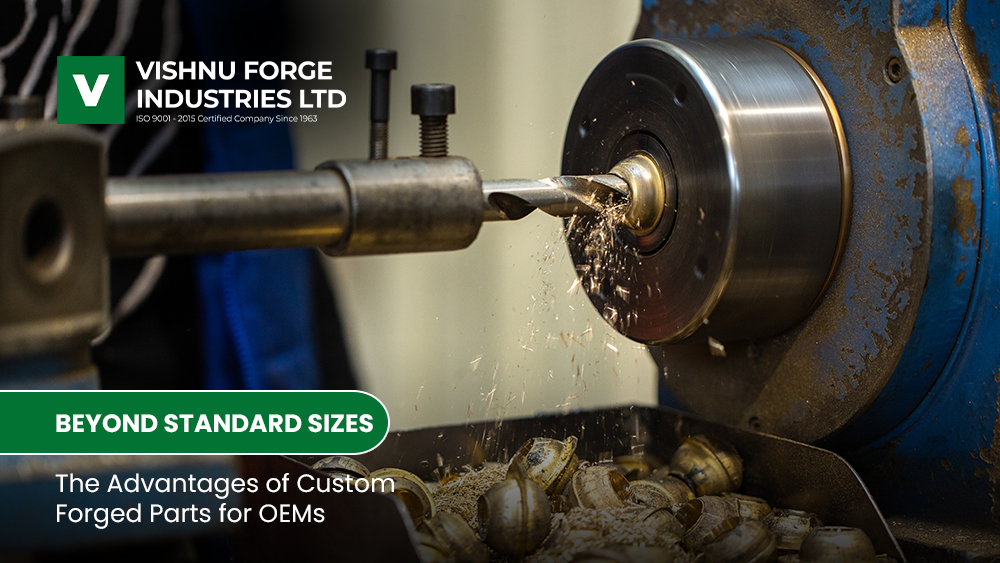
Custom tooling enables a forging parts manufacturer to produce components which need minimal secondary machining. The forging process enables production of flanges, bores and shoulders and connection interfaces with finished dimensions that exceed standard blank production limits. For OEMs who operate under strict assembly time requirements, this process leads to decreased machining duration, lower scrap production and improved production schedule accuracy.
The global metal forging market will generate USD 101.76 billion in 2025, according to Grand View Research, which predicts a 7.4% compound annual growth rate that will continue until 2030 because industrial sectors worldwide sustain their demand for high-quality forged components.
Source: Grand View Research: Metal Forging Market
What OEMs Gain Beyond Material Strength
Custom forgings provide multiple benefits which improve supply chain operations. The industrial products manufacturer reduces incoming goods process variability through their selection of a custom forging supplier who meets their approved drawing and material specification requirements. The parts arrive at their destination with higher completion levels because they include documented mechanical properties and traceable heat numbers, which make quality audits easier to conduct.
The oil and gas, railway, shipbuilding, and heavy electrical industries, which face strict government regulations, require complete traceability from their raw materials to their finished forged products. A forging parts manufacturer with in-house metallurgical labs, heat treatment facilities, and documented QA processes provides OEMs with exactly the accountability chain their compliance requirements demand.
The automotive forging segment, which Fortune Business Insights estimated at USD 54.96 billion in 2025, shows how OEMs now prefer to purchase precision application-specific forgings instead of common commodity items.
Source: Fortune Business Insights: Automotive Forging Market
Custom forgings also enable more accurate lifecycle planning. Maintenance engineers who design parts for specific applications can accurately predict their wear patterns. The process of replacement becomes predictable, inventory control becomes more efficient, and unexpected equipment failures decrease.
Conclusion
OEMs need custom forged components because standard catalogue parts cannot deliver three essentials: alignment with actual load paths, matched material properties, and audit-ready supply documentation. These requirements do not represent premium options. The requirements stand as essential engineering needs for all situations which involve potential component failure because it results in actual operational expenses.
The need for forging partners who can create products directly from engineering drawings will increase as all industrial sectors move toward higher-performance and longer-lasting operations. The design cycle offers OEMs their greatest benefit when they establish supplier relationships because it leads to better production efficiency and higher field reliability results.
Vishnu Forge provides six decades of expertise in closed-die and open-die and ring rolling and press forging operations because they maintain all essential functions within their facility, including machining, heat treatment and complete metallurgical quality assurance. Their technical team offers application requirement discussions.