

A forged valve is one of the most critical components in any high-pressure industrial system. Yet for all the impressions it generates in search — and there are thousands — it remains one of the least explained. Most pages either go too shallow or assume too much. This guide does neither.
Whether you’re a procurement engineer specifying forgings for valve components, a design engineer deciding between forged and cast bodies, or a plant manager evaluating forged valve parts for replacement — this article covers what you actually need to know: how the valve body forging process works, what each part does, which materials suit which conditions, and why industries from refining to shipbuilding rely on forged valves over any alternative.
At Vishnu Forge Industries Ltd (VFIL), we manufacture precision-forged components for valve manufacturers and OEMs across India and internationally. What follows draws on that experience.
What Is a Forged Valve?
Forged valves are industrial flow-control devices whose pressure-containing components — primarily the body and bonnet — are manufactured through the valve forging process rather than casting or fabrication. Forging involves compressing a heated solid metal billet under high pressure in a die, which shapes the part while aligning its internal grain structure along the contours of the component.
The result is structurally different from a cast valve at the microstructural level. Where casting creates randomised grain boundaries and can introduce porosity, shrinkage voids, and inclusions as the metal solidifies, forging produces a dense, continuous grain flow that follows the part geometry. This is what gives forged valves their defining characteristics: higher strength-to-weight ratio, better fatigue resistance, and more predictable failure behaviour under stress.
For a full explanation of forging methods — open-die, closed-die, and ring rolling — see our detailed guide: What Is Forging? Different Types of Forging Processes.
Forged Valve vs Cast Valve — The Key Differences
This comparison comes up constantly in procurement and engineering discussions, so it deserves a direct answer rather than a vague ‘it depends’.
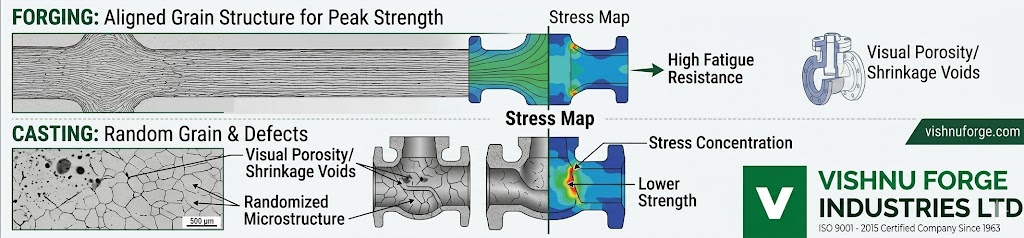
| Forged vs Cast Valve — Side by Side
STRENGTH: Forged valve bodies have ~20–30% higher tensile strength than equivalent cast parts due to continuous grain flow. Cast valves have interrupted grain boundaries at solidification interfaces. DEFECTS: Forging eliminates porosity, shrinkage cavities, and inclusions common in castings. These defects are the most frequent cause of premature valve failure in service. PRESSURE RATING: Forged construction is mandatory for Class 800 and above per ASME B16.34. Cast construction is limited to lower pressure classes in critical service. COST: Forged valves cost more upfront. Cast valves have lower initial cost but higher lifecycle cost in demanding applications due to shorter service life and maintenance frequency. BEST FOR: Forged = high-pressure, high-temperature, cyclic service, safety-critical systems. Cast = low-pressure, moderate service, large-bore applications where cost is primary driver. |
We cover this in full detail in our dedicated article: Forged vs. Cast Valves — Which Is Right for Your Application?.
Valve Body Forging: How the Process Works
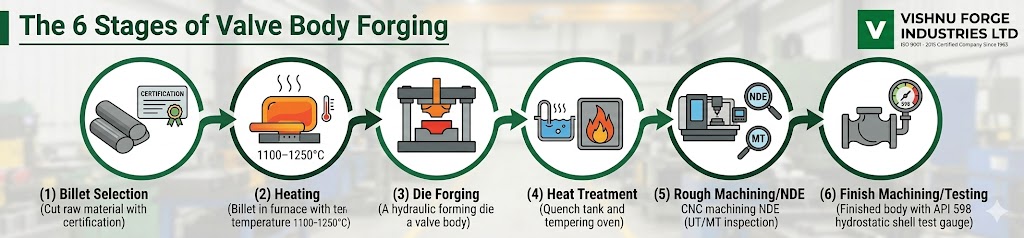
Valve body forging is the manufacturing process by which the main pressure shell of a valve is produced from a solid metal billet. It is the most structurally important step in valve manufacture, because the body is the primary pressure boundary — everything else (stem, disc, seats, packing) operates inside it or depends on it for containment.
Understanding the process helps engineers and buyers evaluate suppliers, specify quality requirements, and avoid the common mistake of treating forged valve bodies as a commodity purchase.
Step 1: Billet Selection and Preparation
The process begins with a steel billet — a solid bar or block of metal cut to a precise calculated weight. Valve body forging requires the billet to be within tight weight tolerances because excess material increases die wear and machining cost, while under-weight billets produce forgings that don’t fill the die cavity, creating laps and cold shuts that fail NDE inspection.
The billet material must be certified to the relevant ASTM or EN standard, with mill test reports showing chemical composition and mechanical properties. Traceability from this point forward is non-negotiable for any valve destined for pressure service.
Step 2: Heating to Forging Temperature
The billet is heated in a furnace to the forging temperature range — typically 1100–1250°C for carbon and alloy steels, lower for austenitic stainless grades. Temperature uniformity across the billet cross-section is critical: a billet that is too cold forges with excessive force and may crack; one that is too hot undergoes grain growth that weakens the finished part.
Step 3: Die Forging
The heated billet is placed in a closed die and compressed using a hydraulic press — press tonnages for valve body forging typically range from 500 to 5,000 tonnes depending on the part size and material. The metal flows to fill the die cavity, forming the valve body shape. This is where the valve forging process imparts its key advantage: the metal grain structure flows with the part geometry rather than solidifying randomly.
Multiple blows or progressive die stages may be used for complex shapes or large parts. Flash — the excess material that squeezes out between die halves — is trimmed in a subsequent press operation.
Step 4: Heat Treatment
After forging, the blank is heat treated to achieve the required mechanical properties. For carbon steel (A105), this is typically normalising — heating above the transformation temperature and air cooling — to refine grain size and relieve forging stresses. For alloy steels (F22, F91), quench and tempering is required to develop the specific strength and toughness combination the standard specifies. Austenitic stainless grades receive solution annealing followed by rapid quenching.
Step 5: Rough Machining, NDE, and Finish Machining
The heat-treated forging is rough-machined to remove scale and bring it close to final dimensions, then subjected to non-destructive examination (NDE) — typically ultrasonic testing (UT) for volumetric defects and magnetic particle testing (MT) or liquid penetrant testing (PT) for surface defects. Only forgings that clear NDE proceed to finish machining.
This sequence — NDE before finish machining — is critical. Finding a defect after finish machining means scrapping a fully-machined part; finding it before means scrapping only the forging blank. For valve manufacturers and EPCs who want to understand how this affects procurement, see our post on choosing a precision forging partner for tolerances.
Step 6: Hydrostatic Shell Testing
The finished valve body is pressure tested per API 598 or ISO 5208 — water pressure applied to the specified test multiple of the rated pressure, held for a defined period, with no visible leakage or pressure drop permitted. This is the final quality gate before the body proceeds to valve assembly.
Forged Valve Parts: What Goes Inside a Forged Valve
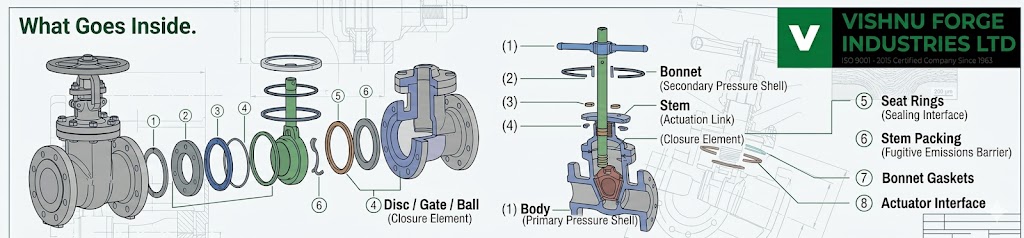
A forged valve is an assembly of multiple precision components. Understanding what each forged valve part does — and why it matters — helps engineers specify the right configuration and helps buyers evaluate what they’re actually getting when they purchase a forged valve.
1. Valve Body — The Primary Pressure Boundary
The body is the main shell. It contains the process fluid, establishes the pressure and temperature rating of the assembly, and provides the connection to the pipeline (flanged, butt-weld, socket-weld, or threaded). In forgings for valve components, the body is the most structurally demanding piece and the one where forging vs. casting makes the most significant difference.
Body wall thickness, bore dimensions, and connection dimensions must meet the applicable valve standard (ASME B16.34, API 600, API 602, etc.). The body material defines the pressure-temperature rating table the valve operates within.
2. Bonnet — The Secondary Pressure Boundary
The bonnet covers the top of the valve body, completing the pressure envelope and providing access to internal parts for maintenance. Bolted bonnets are standard for moderate-pressure applications; pressure-seal bonnets are used in Class 900 and above, where internal pressure actually energises the seal rather than working against it — a configuration that makes the higher the pressure, the tighter the seal.
3. Valve Stem — Transmitting Force and Motion
The stem connects the operator (handwheel or actuator) above to the closure element (disc, gate, or ball) below. It must resist torsional stress, bending loads, and galling — particularly in rising-stem designs where the stem travels in and out of the packing on every operation.
Stem diameter and material are specified relative to the required operating torque. Stems in corrosive service are typically upgraded to 17-4 PH stainless or hard-faced alloy to resist galling. The stem also defines the valve’s fail-safe behaviour in actuated configurations.
4. Disc / Gate / Ball — The Closure Element
This is the moving part that opens and closes the flow path. Its form varies by valve type: a wedge gate in a gate valve, a flat or angle-faced disc in a globe valve, a sphere with a through-bore in a ball valve, or a rotating disc in a butterfly valve. In forged valve parts, the closure element often receives additional surface treatment — hard facing with stellite or tungsten carbide — in erosive or high-cycle applications.
5. Seats — Where Shutoff Performance Is Determined
Seat rings are the sealing surfaces against which the closure element presses. Their surface finish, hardness differential with the disc face, and geometry determine the valve’s shutoff class per ANSI/FCI 70-2 (Class IV through Class VI). In high-pressure service, seat rings are typically pressed, threaded, or welded into the body — not simply machined into the casting — to allow replacement when wear occurs.
6. Stem Packing — The Fugitive Emissions Barrier
Packing fills the annular space around the stem to prevent process fluid escaping to atmosphere. In modern industrial valves, packing selection is driven as much by emissions regulations (ISO 15848, TA Luft) as by service conditions. Expanded graphite and PTFE-based packings are standard; live-loaded packing systems with spring-loaded followers maintain seating load as packing creeps under temperature cycling.
7. Bonnet Gaskets — Sealing the Body-Bonnet Joint
Spiral-wound gaskets with inner and outer rings are standard for most forged valve pressure classes. Ring-type joint (RTJ) gaskets are used in high-pressure, high-temperature service where the harder metal-to-metal seal is required. Gasket selection must match the flange facing (raised face vs. ring groove) and the pressure-temperature class.
8. Actuator Interface — Enabling Automation
Most industrial forged valves are operated by pneumatic, hydraulic, or electric actuators rather than handwheels. The valve body must be designed with compatible actuator mounting flanges (ISO 5211 standard), stem dimensions, and torque ratings. For forged valve parts used in automated systems, the stem-to-actuator interface is a critical design dimension that must be coordinated between the valve supplier and actuator supplier.
We supply custom valve body and stem forgings to actuator-ready dimensions. Explore our custom forged parts for OEMs page for more.
Types of Forged Valves and Their Applications
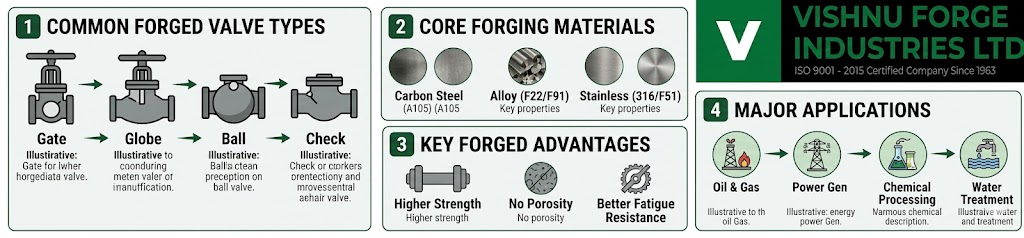
Forged Gate Valve — Full-Bore Isolation
Forged gate valves are the standard choice for mainline isolation service — full open or full close, with the gate rising out of the flow path entirely when open to minimise pressure drop. The wedge-shaped gate and body seats must be precisely matched for shutoff; misalignment or wear shows up as leakage past the seat.
They’re specified in oil and gas transmission, water treatment, steam distribution, and chemical plant isolation service. ASME B16.34 Class 800, 1500, and 2500 gate valve bodies are almost universally forged.
Forged Globe Valve — Throttling and Control
Forged globe valves are designed for throttling — controlling flow volume rather than simply stopping it. The disc moves perpendicular to the flow, creating a variable orifice. They offer good throttling resolution and positive shutoff, at the cost of higher pressure drop than gate or ball valves.
They’re the workhorse of boiler feedwater systems, steam conditioning, and chemical plant process control where the flow rate needs to be set and held reliably.
Forged Ball Valve — High-Speed Shutoff
Forged ball valves use a ported sphere that rotates 90° for full open to full close. They’re fast, reliable, bubble-tight, and require minimal operating torque — which is why they dominate oil and gas production and processing applications where speed of isolation matters and leakage is unacceptable.
The growing demand for forged valves in India’s refinery and pipeline sector has been driven significantly by ball valve requirements. Read our analysis: Demand for Forged Valves in the Indian Valve Industry.
Forged Check Valve — Preventing Backflow
Check valves allow flow in one direction and close automatically when flow reverses. In pump and compressor discharge lines, a forged check valve protects equipment from reverse-flow damage. The forged body is specified because these valves experience sudden dynamic loading — the disc slams shut under flow reversal — that would quickly damage a cast body.
Forged Butterfly Valve — Large-Bore Efficiency
Butterfly valves use a rotating disc to control flow and are compact relative to their bore size. They’re common in water treatment, HVAC, and process applications at larger diameters where the compactness and lower weight compared to gate valves is an advantage.
Materials for Forged Valve Bodies and Parts
Material selection defines every other aspect of a forged valve’s performance: its pressure-temperature rating, corrosion resistance, weldability, and cost. Here are the grades commonly used for valve body forging and forged valve parts:
Carbon Steel — ASTM A105 / A350
ASTM A105 is the workhorse grade for valve body forging at standard service temperatures (-20°F to 800°F). It offers excellent machinability, good weldability, and is cost-effective for the vast majority of oil & gas, water treatment, and general industrial applications. A350 LF2 is the corresponding low-temperature grade, tested for impact toughness to -46°C.
Alloy Steel — F22 (2.25Cr-1Mo) and F91 (9Cr-1Mo-V)
For high-temperature steam service in power generation, alloy steel valve body forgings in F22 or F91 are standard. F91 (Grade 91) is now specified in ultra-supercritical boilers operating above 600°C, where its creep strength far exceeds anything carbon steel can offer. Both grades require controlled post-forge heat treatment and careful post-weld heat treatment in fabrication.
Stainless Steel — 316, 316L, 304, F51 Duplex
Stainless steel forged valve parts are specified where corrosion resistance is the primary requirement: chemical processing, food and pharmaceutical, offshore, and marine applications. 316L (low carbon) is preferred for welded assemblies. Duplex (F51/UNS S31803) and super duplex (F55/UNS S32760) offer significantly higher strength than austenitic grades alongside excellent pitting resistance — valuable in offshore and desalination service.
For a detailed material comparison in similar applications, see our article on carbon vs. stainless steel flanges — the material logic applies directly to valve bodies.
Nickel Alloys — Inconel, Monel, Hastelloy
For the most aggressive environments — concentrated acids, fluorine service, high-temperature oxidising conditions — nickel alloys are specified. These are expensive, require specialist forging capability, and have long lead times, but in the right application there is no substitute.
Forged Valve Applications Across Industries
Oil & Gas — The Core Demand Driver
The oil and gas sector is the largest market for forged valves, driven by the combination of extreme operating conditions and zero-tolerance for leakage or failure. Wellheads, Christmas trees, manifolds, production separators, pipeline mainline isolation, and refinery process units all rely on forged valve bodies that can handle pressures from 1,500 to 15,000 PSI and temperatures from cryogenic to 700°F+.
Standards like API 6A (wellhead), API 600 (gate valves), and API 602 (compact gate valves) specify forged construction because the consequence of failure at these conditions is catastrophic. Our oil exploration sector capabilities cover how we support this market with API-compliant forgings.
For more on forged components specific to this sector: Critical Role of Forging Components in Oil & Gas Industrial Valve Applications.
Power Generation — Steam Valve Forgings
Thermal and nuclear power plants require forged valve parts that can cycle reliably for 30+ years in high-pressure steam service. Gate and globe valves in alloy steel (F22, F91) are specified for main steam and feedwater lines. The shift to ultra-supercritical boilers is driving demand for advanced F91 and modified 9Cr forgings with tightly controlled chemistry and elevated temperature impact properties.
See how precision forging directly improves valve performance in this sector: How Precision Forging Enhances Performance in Industrial Valve Manufacturing.
Chemical and Petrochemical Processing
Chemical plants run streams that are corrosive, flammable, or toxic — often simultaneously. Forged valve bodies in duplex stainless, super duplex, or nickel alloy are specified because the engineering safety margin they provide cannot be achieved with cast alternatives in critical isolation and control service.
Read how forged components enhance the durability of industrial valves in these demanding environments.
Water Treatment — Forgings for Water Treatment
Municipal water and wastewater systems need gate and butterfly forgings for water treatment applications that can handle decades of service in buried or submerged conditions with minimal maintenance. Corrosion resistance, dimensional stability, and long replacement intervals are the primary drivers. Ductile iron and bronze have traditionally dominated here, but stainless and carbon steel forged valves are increasingly specified for critical isolation points.
Marine and Shipbuilding
Ships operate in one of the harshest environments any forged valve parts face: saltwater corrosion, vibration, shock loading, and the absolute requirement for reliability in ballast, bilge, and fire suppression systems. Naval brass, duplex stainless, and forged bronze are standard materials for marine valve bodies. Our shipbuilding industry capabilities detail the material and certification requirements.
Quality Standards and Inspection for Forged Valves
Producing high-quality forgings for valve components requires adherence to a layered quality framework — from raw material to finished assembly. Here’s what that looks like in practice:
Applicable Standards
The key standards governing forged valve construction and inspection:
- ASME B16.34 — Valves: flanged, threaded, and butt-welding end (pressure-temperature ratings)
- API 600 — Steel gate valves for petroleum and natural gas industries
- API 602 — Compact design carbon steel gate valves
- API 6A — Wellhead and Christmas tree equipment
- API 598 — Valve inspection and testing
- ASTM A105 / A182 / A350 — Carbon, alloy, and stainless steel forging materials
- EN 12516 — Industrial valves, shell design strength (relevant for UK/European market)
- BS 1414 — Steel gate valves for petroleum, petrochemical, and allied industries (UK spec)
NDE Requirements
Non-destructive examination of valve body forgings typically includes: UT (ultrasonic testing) for volumetric examination per ASTM A388, MT (magnetic particle testing) per ASTM E709 for surface and near-surface defects in ferromagnetic materials, and PT (liquid penetrant testing) per ASTM E165 for non-ferromagnetic grades. Acceptance criteria are set by the applicable valve standard.
Dimensional Inspection
Forged valve bodies must meet the dimensional requirements of ASME B16.34 Table 1 or the applicable valve standard — face-to-face, end-to-end, bore tolerances, flange drilling, and face finish. For customers with tighter requirements, we supply forgings to customer-provided drawings with CMM inspection reports. Read our post on precision forging tolerances.
| VFIL Quality Credentials
ISO 9001:2015 certified forging and machining process Full material traceability — heat certs retained from billet to finished forging In-house UT, MT, PT, and dimensional inspection capability Forgings supplied to ASTM, EN, IS, API, and customer-specific standards Exports to Europe, Middle East, and Southeast Asia — view our export capabilities → |
Challenges in Sourcing and Manufacturing Forged Valve Components
Lead Time — The Longest Item on the BOM
For valve OEMs, valve body forging lead time is consistently the longest item on the bill of materials. Raw material procurement, forging, heat treatment, NDE, and machining typically takes 8–16 weeks for standard carbon and alloy steel grades — and significantly longer for specialty alloys. Choosing a forging partner with integrated capabilities (in-house furnace, press, heat treatment, NDE, and machining) is the most effective way to compress this.
See how the right forging partner approach reduced valve component lead time by 30%.
Metallurgical Consistency
Maintaining consistent mechanical properties — yield strength, impact toughness, hardness — across a production batch is the hardest technical challenge in forged valve production. Small deviations in forging temperature, die alignment, or heat treatment parameters can shift properties enough to cause batch rejection. Process monitoring, statistical control, and regular die maintenance are non-negotiable for high-volume production.
Near-Net-Shape Forging to Reduce Machining Cost
The closer the forging blank is to the final part shape, the less material is machined away — and machining is expensive. Investing in higher-quality dies that produce near-net-shape valve body forgings pays back through lower machining cost and faster throughput. For high-volume valve programs, this cost optimisation is where the real savings come from, not from cutting material quality or NDE.
Frequently Asked Questions About Forged Valves
These questions reflect what engineers and procurement managers actually search for — answered directly.
| Q: What is a forged valve?
A forged valve is an industrial flow control device whose body and main pressure-containing parts are manufactured by the forging process — compressing heated metal under high pressure in a die — rather than by casting or fabrication. The forging process aligns the metal grain structure with the part geometry, producing a denser, stronger, and more fatigue-resistant component than casting achieves. |
| Q: What is valve body forging?
Valve body forging is the process of manufacturing the main pressure-containing shell of a valve from a solid metal billet using compressive force in a die. The steps are: billet selection → heating → die forging → flash trimming → heat treatment → rough machining → NDE → finish machining → hydrostatic testing. The forged body’s continuous grain structure is what gives forged valves their pressure rating and fatigue resistance advantage over cast alternatives. |
| Q: What are the main parts (forgings) for valve components?
The main forgings for valve components are: (1) body — primary pressure shell, (2) bonnet — secondary pressure boundary and maintenance access, (3) stem — connects actuator to closure element, (4) disc/gate/ball — the closure element itself, (5) seat rings — sealing surfaces, (6) gland — compresses the packing around the stem. Each requires its own material specification and dimensional tolerances per the applicable valve standard. |
| Q: What is the difference between forged valve and cast valve?
The core difference is the manufacturing process and resulting microstructure. Forging compresses solid metal to align grain structure, eliminating porosity and producing higher strength. Casting pours molten metal into a mold, which can introduce porosity, shrinkage defects, and random grain structure. For high-pressure and high-temperature service, forged valves outperform cast in strength, fatigue resistance, and service life. Cast valves are economical for low-pressure, large-bore applications where the forged strength advantage is not needed. |
| Q: What is the valve forging process step by step?
The valve forging process steps are: (1) Billet selection and weight calculation; (2) Heating to forging temperature (typically 1100–1250°C for steel); (3) Die forging — pressing the billet into the die cavity under 500–5,000 tonnes of force; (4) Flash trimming; (5) Heat treatment — normalising, quench-and-temper, or solution anneal depending on grade; (6) Rough machining and surface scale removal; (7) Non-destructive examination (UT, MT, or PT); (8) Finish machining to final tolerances; (9) Hydrostatic shell testing per API 598 or ISO 5208. |
| Q: What materials are used for forged valve bodies?
The most common materials for forged valve bodies are: ASTM A105 (carbon steel, standard service), ASTM A350 LF2/LF3 (carbon steel, low-temperature service), ASTM A182 F22 (2.25Cr-1Mo alloy steel, high-temperature steam), ASTM A182 F91 (9Cr-1Mo-V, ultra-supercritical steam), ASTM A182 F316/F316L (austenitic stainless steel, corrosive service), ASTM A182 F51 duplex stainless (offshore and chemical service), and nickel alloys (Inconel 625, Hastelloy C276) for the most aggressive environments. |
| Q: What standards apply to forged valves?
Key standards for forged valves include ASME B16.34 (pressure-temperature ratings and construction requirements), API 600 (steel gate valves for oil and gas), API 602 (compact carbon steel gate valves), API 6A (wellhead equipment), API 598 (inspection and testing), EN 12516 (industrial valves, European standard), BS 1414 (steel gate valves, UK/British standard), and ISO 5208 (pressure testing). Material forgings are covered by ASTM A105, A182, A350, and equivalent EN/IS standards. |
| Q: Where are forged valves used?
Forged valves are used in: oil and gas (upstream wellheads, midstream pipelines, downstream refineries), power generation (main steam, feedwater, and reheater circuits), chemical and petrochemical processing, water treatment and infrastructure, marine and shipbuilding, LNG and cryogenic facilities, and industrial gas handling. They are specified wherever pressure, temperature, or safety requirements exceed what cast valve construction can reliably meet. |
| Q: What are forgings for water treatment applications?
Forgings for water treatment include gate valve bodies, globe valve bodies, check valve bodies, and butterfly valve disc hubs made from carbon steel (A105), ductile iron, stainless steel (316/316L), or duplex stainless depending on the water chemistry and pressure. These forgings must resist chloride-induced corrosion in treated water service and provide the long maintenance intervals (often 20+ years) required for buried or infrastructure-critical installations. |
| Q: How long does a forged valve last?
Well-specified and properly maintained forged steel gate and globe valves routinely achieve 20–30 years service life, with the forged body itself rarely being the failure point. Common wear items are stem packing, seat surfaces, and actuators. In erosive or chemically aggressive service, life is shorter — but forged construction offers more predictable degradation and easier maintenance access than cast alternatives. |
Conclusion
A forged valve is more than a flow control device — it’s a precision-forged assembly whose performance is determined as much by the valve body forging process and the quality of individual forged valve parts as by the valve design itself. Understanding this gives procurement teams, design engineers, and plant operators the foundation to specify correctly, evaluate suppliers honestly, and avoid the costly mistakes that come from treating forgings for valve components as a commodity.
At Vishnu Forge Industries Ltd, we manufacture forged valve bodies, bonnets, stems, and custom assemblies for valve manufacturers and OEMs across India and internationally. Our forgings meet ASTM, EN, IS, and API standards, with full material traceability, in-house NDE, and ISO certification. View our product range, explore our valve manufacturer supply page, or contact our team to discuss your requirements.