

Manufacturers in precision gear production face three major challenges because of inconsistent product quality and unexpected equipment breakdowns, which damage their business operations. Gears produced without tightly controlled processes face increased risk of developing internal defects and weak zones, which results in decreased strength and long-term reliability.
The automotive sector, industrial machinery sector, and heavy equipment sector all show increasing demand for high-performance gear products. The production process becomes more challenging because machines must deliver precise measurements and constant output during expanding production volumes. These standards become harder to achieve because our forging process lacks essential strength.
The controlled closed-die forging process produces gear blanks that achieve optimal grain flow and structural integrity through its controlled settings. This approach delivers measurable improvements in strength and durability, supporting the performance requirements of the gear manufacturing industry and other demanding applications.
The Growing Importance of Forged Gears
Gears serve as essential mechanical components that enable machines to transfer power and movement throughout their systems. The products must withstand substantial weight, endure multiple stress cycles, and meet precise size specifications. Gear blanks that lack sufficient accuracy will result in system failure and operational issues, which will have a system-wide impact on performance.
The manufacturing industry needs precision techniques such as closed-die forging because automated and electrified systems now require manufacturers to achieve tighter tolerances and improved system reliability.
What Is Closed-Die Forging?
Closed-die forging is a metal forming process in which a heated metal billet is placed between two custom-machined dies. The dies are designed to create the exact shape of the gear blank through their negative space. The die cavities are filled when the billet material is subjected to specific pressure and temperature conditions, which result in the formation of the gear blank’s initial shape.
This method produces mechanical properties that other techniques, which include casting and machining from solid bar stock, cannot achieve with consistent reliability. The closed-die forging process develops advanced material properties because it enables precise control over material movement and force application during production by the forging company.
Step 1: Material Selection and Billet Preparation
The process begins with selecting the right alloy based on the gear application. Common gear materials include alloy steels that offer strength and wear resistance appropriate for heavy-duty applications. The metal billet will be prepared for forging after it has been selected.
Proper preparation ensures consistent input to the forging press, which results in predictable material flow. The current stage of work includes quality checks that verify billet surface condition, weight, and composition.
Step 2: Heating to Forging Temperature
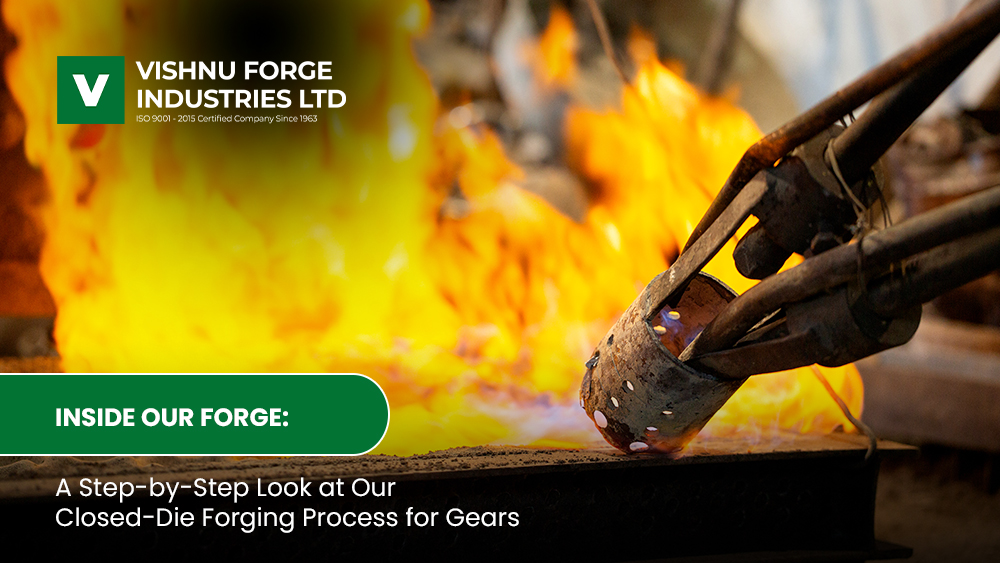
The prepared billet is then heated in a controlled furnace to achieve optimal forging temperature. The temperature needs to be controlled because it determines how materials behave when they become plastic and how they fill the die. The correct heating range enables material flow during load testing, which decreases the possibility of cracks and incomplete material formation.
The process of temperature control at precise levels helps to create finer grains, which results in improved fatigue resistance and extended operational life.
Step 3: Closed-Die Forging Operation
The billet needs to reach its forging temperature before workers can transfer it to the forging press. The closed-die forging system uses high-capacity presses that apply exact force to shape metal inside pre-machined dies.
The dies are designed to produce gear blanks that meet specific tolerance and surface finish standards. The forging process applies force to the material, which enables it to occupy every die section, thereby producing a shape that needs only slight machining.
Closed-die forging creates better internal grain flow, which results in forged gear blanks that have higher strength and better mechanical fatigue resistance than cast or machined blanks.
Step 4: Flash Trimming and Inspection
The gear blank develops flanges, which are extra material segments that extend beyond its forged shape. The excess material needs to be trimmed until the design specifications have been met. The process starts with flash trimming before moving on to the cleaning and cooling stages.
The inspectors check each forged component through both visual inspection and size measurement. The inspection process confirms that the forged gear blank meets all specifications regarding its dimensions, shape, and structural integrity. The advanced quality control system reduces the possibility that defective products will proceed to the next steps of machining and finishing work.
Step 5: Heat Treatment and Finishing
The forged blanks need heat treatment because it produces their ultimate mechanical properties, which include hardness and wear resistance. The process requires controlled heating and cooling cycles to create microstructure changes that achieve the desired engineered performance standards.
The gear blanks proceed to precision machining after heat treatment ends because customers need their specific tooth cutting, grinding, and finishing requirements to be met.
Why Closed-Die Forging Matters for Quality and Performance
Closed-die forging serves as an essential procedure for gear production companies because it establishes a foundational base that enables subsequent machining and finishing operations. The controlled grain flow and structural integrity of closed-die forged materials result in better durability and extended service life, and reliable performance during demanding operational conditions that require high dependability.
The forging company needs this process to maintain its competitive edge while it meets both quality standards and industry requirements.
Conclusion
The closed-die forging process requires makers of gears to use precise methods because their work requires meticulous control. The entire process from selecting materials until finishing heat treatment delivers essential results that determine the dependability and functionality of gears needed for heavy machinery, automotive transmission systems, and all other vital applications.
Companies in the gear manufacturing industry achieve long-term success through advanced forging processes because these methods deliver products that meet market demands for both quality and durability.
Vishnu Forge provides industries with precision forged gear blanks that meet their needs for high-integrity projects through its advanced manufacturing techniques. Vishnu Forge operates as a reliable forging service provider that serves multiple industrial sectors while delivering precise components through its established procedures and strict quality control measures. Vishnu Forge invites you to discover custom forging options that match your specific gear requirements through direct contact with their team.