

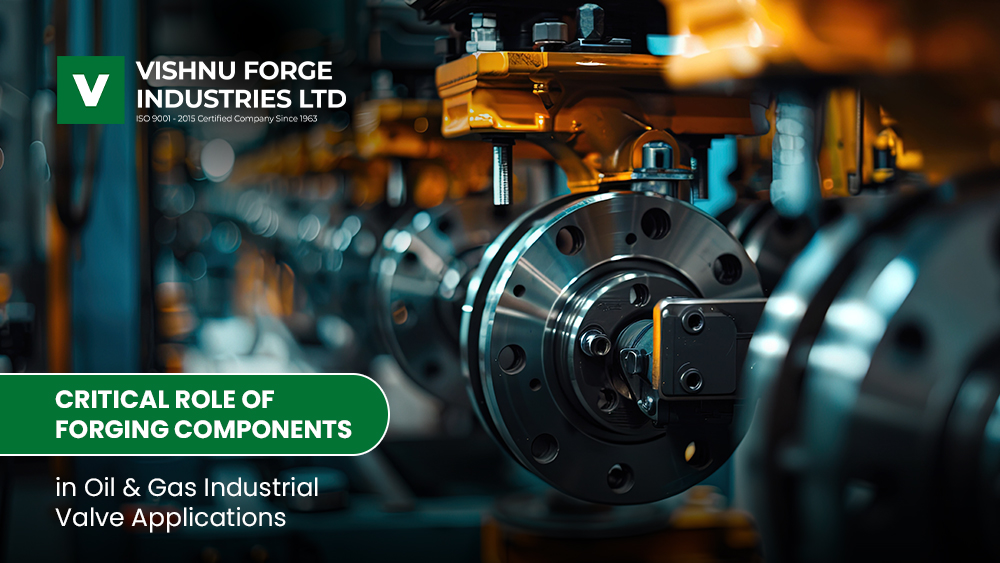
For an oil and gas industry prospect, one would picture offshore oil rigs, oil refineries, and pipelines. However, industrial valves that control, move, and store critical oil and gas liquids are also important and may be overlooked. These industrial valves are crucial in controlling the oil and gas liquids. Valves control the flow, pressure, and safety to ensure reliable performance. It suffices to say that valves remain functional despite extreme temperatures and pressure as a result of forgings.
Forging plays an important and unique role in industrial valves as it is the most reliable way of ensuring the safety, performance, and durability of the forged valves.
Importance of Forging Valves
Forging is a unique and vital process, especially in the oil and gas industry. Forging refines the grain structure of a metal, which in turn improves mechanical strength, unlike casting, which is also a metalworking process. Forging compresses and reshapes solid metal rather than allowing it to flow freely in molten form. In the oil and gas industry, metal valves are subject to extreme pressure as well as internal gas and oil pipelines.
Crude oil, natural gas, and various chemicals fall under the category of corrosive substances and, therefore, require special precautionary measures.
The temperature must be controlled. It can change in quick succession, up to and including several seconds.
Assuring no cracking, leaking, or deformation is achieved requires every valve part — bodies and bonnets to flanges and stems — to be designed and built to the highest possible structural specifications. The process of forging achieves that.
The Science Behind Stronger Forged Valve Components
When metals are forged, their internal grains align in a pattern that matches the shape of the component. This allows for a more homogeneous piece and the removal of “weak” areas. Forging yields the following improvements:
- Tensile strength — the valve body will withstand more stress and be more durable.
- Impact resistance — especially important regarding pressure surges.
- Fatigue life — the valve will withstand prolonged operation.
High-pressure oil refineries, gas pipelines, and offshore platforms are examples of forged apparatus critical to valve system applications.
Forged Components Used in Industrial Valves
Now, let’s discuss the application of forged pieces in industrial valve construction.
Primary load-bearing components of a valve are the bodies and bonnets. Forging improves strength by eliminating internal voids and porosity, allowing the body to withstand pressure and corrosive environments.
Flanges and End Connections
Forged flanges provide leak-proof connections between pipelines and valves. Because of the uniform grain structure of the forged flanges, they are able to maintain a tight seal even when the pressure changes.
Stems and Shafts
Moving parts in a valve need to have exceptional fatigue resistance and wear resistance. Forged stems provide the mechanical integrity to ensure the valve will work repeatedly without failure.
Discs, Plugs, and Seats
Forged components can be precision machined for close-tolerance work in which these components will come in direct contact with the fluids. This will ensure a proper seal and will provide the desired flow control in the valve.
Forging components are the most essential parts in fabricating a reliable valve system. This is why valves are made with forged components.
Forging Versus Casting and Machining
The valve manufacturing industry has used and tried various production techniques for valves, such as machining, fabrication, and even casting. Yet the most commonly used method for production remains forging for several reasons:
- Forging has no hidden defects such as porosity or shrinkage, which are among the disadvantages of casting. This ensures the safety of the valve.
- Forged components provide higher mechanical strength with a higher strength-to-weight ratio.
- Every forged component has consistent and uniform material properties, which ensure the predictability of performance no matter the operational conditions.
- The lifespan of a valve will increase due to the reduction of defects, maintenance, and downtime. This is particularly important in the oil and gas industry, where downtime is the most critical.
Forged valves don’t just perform better — they last longer.
Applications of Forged Valves in the Oil & Gas Industry
Valves are a cornerstone of the oil and gas supply chain and for strategic oil and gas operations, including:
- Upstream exploration and drilling, where high-pressure valves control the flow of crude oil.
- Midstream transport systems, where valves are crucial for the safe transport of oil and gas.
- Downstream refining, where valves control the temperature and chemical processing during various stages of oil and gas storage and refining.
In all of these operations, the ability for forged valves to provide structural integrity and leak-proof functionality under high pressure is unmatched by cast valves.
Sustainability and Safety: The Forging Advantage
Forging can positively impact efficiency and sustainability goals. Compared to other processes, forged valves need less rework, fewer failures, and provide safer and more energy-efficient operations. The sustainable design and integrity of fasteners forged under high temperature will contain system and environmental leaks and be efficiently safe in processes where leaks and failures are costly.
This explains the continued investment in the forging process by valve manufacturing companies, as it relates to the safe, sustainable, and efficient use of resources.
Wrapping It Up
Forged components are indispensable in the industrial manufacture of valves. From deep-sea drilling rigs to massive refinery plants, they provide the strength, precision, and reliability that high-pressure environments demand.
Those involved in the oil and gas supply chain, or in the manufacturing of valves, ought to seek associations with those who comprehend the importance of forging in their operations.
Vishnu Forge is renowned in the field of forging, having developed precision-forged components for over 30 years, and prides itself on delivering engineered solutions with leading strength, safety, and performance.
Learn about the advanced forging technologies that Vishnu Forge employs in the construction of durable valves for extreme conditions.