

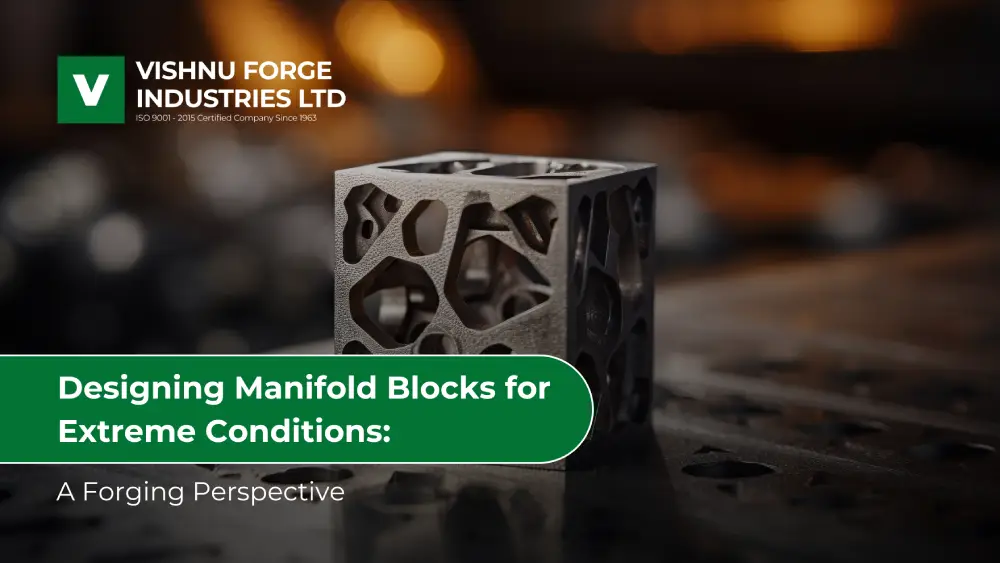
The Critical Role of Manifold Blocks in Industrial Systems
Core Functions and High-Stakes Environments
Manifold blocks are the nerve centers of hydraulic and pneumatic circuits. They channel, control, and distribute fluids under immense pressure—often across a labyrinth of ports and valves. From oil exploration rigs buried beneath the ocean floor to high-temperature furnaces in metallurgical plants, these components face a gauntlet of extreme stressors every second. The margin for error? Nonexistent.
Where Standard Designs Fail and Forging Excels
Conventional casting methods often fall short in high-performance environments due to micro-defects and inconsistent grain structures. The result: premature fatigue, cracking, and unpredictable performance. Forged manifold blocks, with their superior metallurgical integrity and fatigue resistance, thrive where others fail. They are engineered not just to function—but to endure.
Engineering Manifold Blocks for Pressure, Heat, and Corrosive Environments
Material Selection: Alloys Built for Extremes
At the heart of every resilient manifold block lies the right alloy. Materials like duplex stainless steel, Inconel, and nickel-chromium alloys are selected not just for their strength but for their chemical resistance and thermal tolerance. These alloys withstand not only soaring temperatures but also abrasive media, salt-laden atmospheres, and high-acidity fluids—all common in sectors like mining, defense, and chemical processing.
Geometry Optimization for Load and Flow Distribution
Designing a manifold block isn’t just about connecting pipes—it’s about mastering pressure dynamics. Engineers optimize channel pathways and wall thicknesses to balance internal flow, reduce turbulence, and minimize stress concentrations. Every angle, bore, and boss is calculated to reduce the likelihood of fatigue failure under cyclical loading or thermal expansion.
Forging Technology: The Key to Structural Superiority
Grain Flow Orientation and Mechanical Endurance
Forging imparts a directional grain structure to the metal that mirrors the contours of the final component. This intrinsic alignment results in manifold blocks that are significantly more resistant to deformation, fatigue, and impact. Unlike casting, which introduces porosity and weak points, forging creates a solid, uniform microstructure that endures the rigors of extreme service.
Post-Forging Heat Treatments and Stress Relief
After the forging process, manifold blocks undergo precise heat treatments to refine hardness, relieve internal stresses, and optimize mechanical characteristics. Quenching, tempering, or annealing treatments are tailored to the end-use environment. These steps ensure that the forged block won’t warp under temperature variations or crack under sudden pressure spikes.
Precision Machining and Surface Finishing for Harsh Applications
Tolerance Control and Sealing Performance
Forged manifold blocks are machined to exacting tolerances to accommodate high-pressure fittings and valve inserts. Superior tolerance control ensures leak-proof sealing surfaces and consistent port alignment across units. This precision is vital in aerospace and offshore applications where failure is not an option.
Anti-Corrosion Coatings and Wear-Resistant Finishes
To further boost performance, surface treatments such as electroless nickel plating, anodizing, or ceramic coatings are applied. These finishes extend the life of manifold blocks by mitigating corrosion, scaling, and surface degradation caused by aggressive media or cyclic wear.
Quality Testing and Performance Validation
Simulated Stress Testing and Non-Destructive Inspection
Before deployment, manifold blocks undergo a series of mechanical and non-destructive tests. Hydrostatic pressure tests, magnetic particle inspections, and ultrasonic scans are conducted to detect subsurface defects and ensure structural integrity. Advanced testing protocols simulate actual working conditions—ensuring the component performs not just in theory, but in the field.
Compliance with Global Certifications and Sector Standards
For manifold blocks destined for global industries, compliance is non-negotiable. Certifications such as ISO 9001, RDSO (for railway), PED (Pressure Equipment Directive), and others validate the quality and reliability of the forged product. These approvals are gateways to international markets—and proof of world-class engineering.
Conclusion: The Forged Advantage in Next-Gen Manifold Block Design
Extreme conditions demand exceptional engineering. Forged manifold blocks are not just components; they are solutions—built for pressure, heat, corrosion, and time. Their performance is not accidental but intentional, forged into every molecule and machined to exacting detail. In industries where conditions push the limits of technology, forged manifold blocks don’t just survive—they lead.