

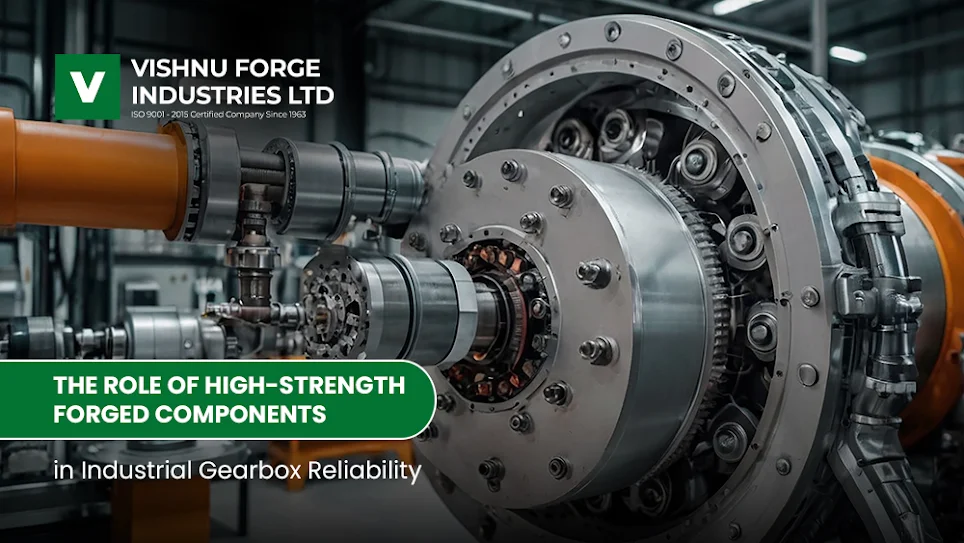
The one truth that all heavy machinery operators should know is that a gearbox breaking down means all operations grind to a halt. This means a complete standstill of production, cost overruns, and missed deadlines. Therefore, the reliability of gearboxes is not an added benefit, but is a bare minimum requirement.
High-strength, forged components are an essential contributor to gearbox reliability. Modern industrial gearbox manufacturers rely primarily on forging to produce gearboxes that endure extreme loads and can operate continuously in demanding conditions.
Forged components are essential and irreplaceable in industrial gearbox production. What other option is there, and what qualities make industrial gearboxes irreplaceably essential? Let’s explore impenetrable strength.
Why Industrial Gearboxes Cannot Compromise on Strength
Industrial gearboxes must adapt to extreme conditions. Mining gearboxes, wind turbine gear systems, and cement factory anvils all endure extreme and constantly changing conditions. Gearboxes must not only withstand but also adapt to and regulate various loads, including impacts, shocks, and constant rotational changes.
In comparison to light-duty systems, industrial gearboxes need to have longer operational lifespans and higher reliability with minimal downtime. Minor faults in any gear, shaft, or coupling could jeopardize the entire system. For this reason, industrial gearbox manufacturers emphasize component strength, fatigue resistance, and structural integrity from the earliest stages of design.
Forging: Developing Strength from the Core
Forging involves creating metal components, but this process also alters the metal’s internal structure. Metal can be shaped through forging, but additional benefits can be achieved by compressing the metal under high pressure, such that the metal’s internal grain structure is refined and realigned along the configured shape of the component.
Forged components offer the following advantages, which are particularly important for gearboxes:
- Increased yield and tensile strength.
- Better resistance to shock loads and fatigue.
- No internal voids or porosity.
- An improved ability to withstand stress under variable cyclic conditions.
Because of these benefits, many manufacturers of forged components provide parts that are technically superior to any alternatives made through casting or fabrication.
Important Components of Gearboxes that are Forged to Enhance Reliability
The worth of a gearbox is determined by its individual components. Forging is important for a number of individual parts that assist in improving the overall performance of a gearbox.
Forged Gears
Gears experience repeated contact stress. Forged gears offer better tooth strength and a longer service life. Less risk of tooth breakage and surface fatigue is due to a refined grain structure that aids in stress distribution.
Forged Shafts
Shafts transmit torque and other crucial drivetrain components. Forged shafts withstand bending, torsion, and vibration better than non-forged alternatives. This becomes critical in high-torque industrial gearboxes; a failing shaft can cause catastrophic damage.
Forged Couplings and Hubs
Hubs and Couplings offer alignment and power transmission with no gaps. Forged Couplings add strength and stability. They keep the balance of the system, even with varying loads.
This explains why top industrial gearbox makers choose component manufacturers who know forging for their gearboxes.
How Forged Parts Cut Down Gearbox Failures
Gearbox failures happen for a reason, and you don’t need to be an expert in machinery to tell that. They arise over time due to fatigue, micro-cracks, deformation, and wear. Forged components limit these failures.
Forged components have critical stress concentrators, enabling them to avoid internal cracks. They also keep their dimension for a long time, which is critical for gear alignment and load distribution.
Practically speaking, this means the following:
- Fewer surprise breakdowns.
- Longer periods between maintenance.
- Reduced costs for repairs and replacements.
- Enhanced efficiency of equipment.
Reliability Equals Lower Total Cost of Ownership
Forged gearbox components have a positive effect on the costs associated with the lifecycle of the gearbox. Forged parts may have a slightly higher upfront cost, but as time goes on, these costs become insignificant.
Less downtime and replacements with longer service lives all result in a lower total cost of ownership for industries with 24/7 operations. This reliability has direct impacts on productivity and profitability.
This long-term value is why industrial gearbox manufacturers have begun viewing forging as a necessity instead of a value add.
Meeting Modern Industry Standards with Confidence
There are numerous quality and safety guidelines that industrial gearboxes need to follow. Due to their uniform mechanical properties and predictable performance, forged parts make it easier to comply with these guidelines.
Advanced forging processes, along with the precise machining and heat treatment, allow all components to meet the specifications. In industries like oil and gas, power generation, and heavy manufacturing, this consistency is critical.
For manufacturers of forged components, consistency is not only a means to gain and maintain compliance, but it is also a means to develop trust and long-lasting relationships.
The Vishnu Forge Advantage
Vishnu Forge reinforces that the reliability of the gearbox starts at the component level. With over two decades of expertise in precision forging, Vishnu Forge builds high-strength precision components to meet the challenges of today’s industrial gearboxes.
Vishnu Forge collaborates with industrial gearbox manufacturers to provide engineered forged gears, shafts, and components for high durability, accuracy, and performance. Vishnu Forge’s quality control, material integrity, and process excellence guarantee every forged part.
Final Thoughts
The industrial gearboxes are under constant stress. Its reliability hinges on the inner components, and high-strength forged components offer the reliability, durability, and fatigue resistance to ensure that the gearboxes continue to run in the most demanding applications.
Strategically, for both manufacturers and end-users, the investment in forged components provides improved performance and reduces downtime for long-term reliability.
Partner with Vishnu Forge for Reliable Forged Solutions
With the proven support of industrial gearbox manufacturers, Vushnu Forge is the optimal partner for customers looking for forging components manufacturers.
Our website provides information on how the reliability and performance of your industrial gearboxes will benefit from our high-strength forged components.