
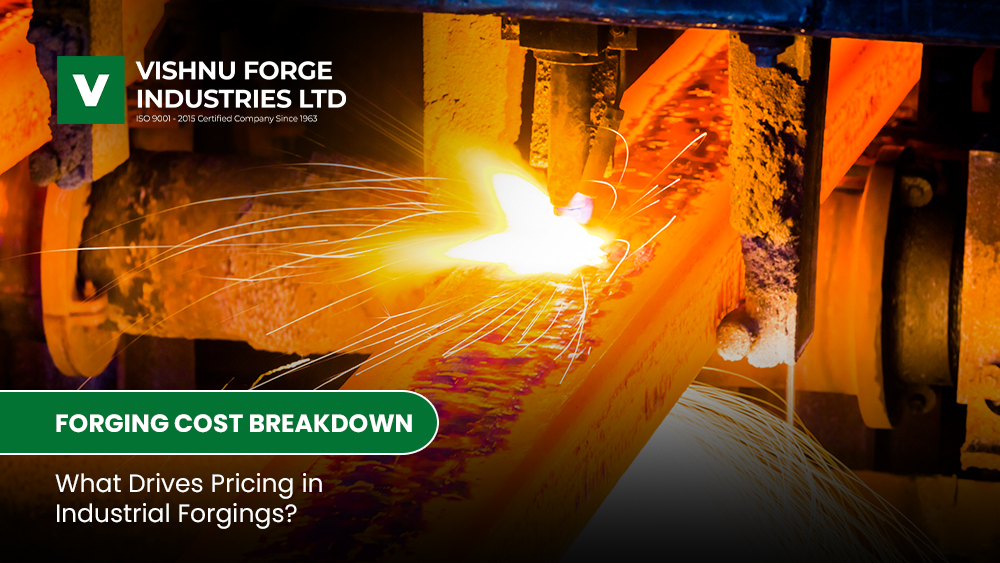
Why is forging so costly? This is a question that all purchasing managers face at one point or another, while comparing two prices that have a variation of around 40% for the same component. The reality is that forging cost cannot always be understood easily. As opposed to commodities that have a standard price per unit or Kg, the Forging Cost Per Kg on any quotation sheet is affected by at least half a dozen factors.
As per the data provided by IMARC Group, the market value of forging products in India is expected to reach a valuation of USD 5.6 billion by 2025, which will register an anticipated CAGR of 7.1% up to 2034. With the growing demand in the auto, defence, and infrastructure sectors, understanding forging price factors becomes necessary to avoid unnecessary expenditure.
This article will give insight into the factors affecting custom forging cost.
Raw Material: The Biggest Slice of the Cost Pie
The material cost contributes 40%-60% of the overall cost per kg forging. Carbon steel falls under the low bracket. Stainless steel, creep-resistant alloy, and titanium take this percentage higher. The carbon steel market alone represents 55% of the total forging production in India, according to Persistence Market Research.
The price of steel depends on the global commodity market. Hence, an order for forging made six months apart will not have the same cost of materials. Clever negotiators would lock down the material price at the start or agree to price changes based on the steel price index. When substitution is possible in terms of materials, alloy steel can be changed to carbon steel.
Die and Tooling Costs: The Hidden Upfront Investment
However, for closed die forging, the cost of the die may prove to be quite significant, particularly when dealing with intricate designs. The dies are manufactured using computer numerical control machining on tool steel, heat-treated, and precisely finished. For example, a medium-complexity forging die may range anywhere between INR 50,000 and a few lakhs.
In open die forging, there is no such requirement, since open dies are usually flat or have simple shapes. This is another factor that makes open die forging more economical in the case of small quantities of large forgings. When quoting custom forging costs, the die cost must be clearly distinguished from the piece rate.
Forging Process Type Affects Your Bottom Line
The selection of the process directly influences the step forging price factors. The process of closed die forging requires less machining due to the use of near-net shape parts and allows for better tolerances. However, the cost of tools and setup increases with this approach. In turn, the process of open die forging is more economical in terms of smaller batches and is more versatile.
It also requires more machining after the forging stage. Press forging provides the uniformity of the grain structure since it does not involve impacts but uses slow and continuous pressure. Press forging is preferred in aerospace and defence products; however, the equipment cost per hour of operation is higher. When selecting the process, economy is not the primary issue.
Heat Treatment and Machining Add Up Quickly
It’s rare that a forged part is immediately usable for assembly. Most require some form of heat treatment (normalising, quenching, tempering, or stress relieving) in order to obtain necessary physical properties. Heat treatment will usually be an additional cost of anywhere between 10%-20% of the basic forging cost per kg, according to the material used.
The other significant cost addition involves machining operations. If you are purchasing rough forgings, your machining work will either be done in-house or contracted out separately. However, when purchasing partially or fully finished parts, machining costs are borne by the forge itself, although they figure in the final piece cost. Forges which do their own CNC machining tend to have an advantage here, due to the lower costs involved.
Order Volume and Repeatability Change the Equation
Scale plays an important part when we speak about forging. For example, the prototype shaft costs many times more per kilogram than its mass-produced counterpart with a batch size of 500 items. Loading, preheating of the dies, testing of the quality, etc., are almost identical in all cases. As a result, the cost per item decreases with volume increase.
Repeat orders are even more profitable from this point of view. The dies have already been prepared, the parameters are known and checked, and the quality standards are set. When you try to estimate the cutting and forging cost for some new design, find out the cost per batch at various sizes. You will be shocked!
Inspection, Testing, and Certification Requirements
For railways, power, and oil exploration, many purchasers demand stage-wise testing, third-party witness, and certain documentation bundles. All three will increase costs for the order. The use of ultrasonic inspection, magnetic particle inspection, impact tests at sub-zero temperatures, and tracing the material is a given when it comes to vital operations.
None of these are matters that can be compromised in any way. However, knowing exactly what is necessary versus what is always included in any order is important to know the forging price factors.
Understanding the Cost Means Controlling the Cost
Pricing in forging is complex. The material, process, tooling, heat treatment, machining, quantity, and testing processes are all interrelated. Two quotes for the same part can vary by 30% or more without either one being incorrect. Differences may be based on assumptions regarding surface finish, testing requirements, or amortisation of dies.
The best customers are those who understand the complexity of forging prices and ask the right questions. They provide clear specifications and evaluate quotations based on the cost involved in producing the required parts, not just on the price alone.
Vishnu Forge Industries offers clear price quotations that break down material, forging, heat treatment, and machining charges. With decades of experience supplying railway, defence, oil exploration, and industrial components, our sales personnel at VFIL can guide you through the costing of your requirements and find you areas for cost savings.